Monday, 25 March 2013

“That’s why they call it ‘labour’”


There is something magical about the birth of a baby. After nine months of getting used to the idea that a little person is growing inside the woman, the time comes that this human parasite is pushed out, in only seconds changing to a breathing and screaming little baby person, growing up to be a be unique individual human being. During my time as an intern at the obstetrics department in a hospital in the Netherlands, this moment was easily so special that it could bring me to tears, especially if the couple showed the some of that amazement, love, and explosive joy towards the new life (and yes, this is not always the case, being in shock is also an option for new parents...).

In the Netherlands the delivery rooms are equipped to make the delivery as personal and special as is possible in the setting of a hospital. In the private delivery rooms lights can be dimmed, there is a comfy chair for the husband, a personal warm shower or a skippy-ball for during the contractions, even a cd-player so that you can bring your own music for it all. The couple is attended by one midwife or nurse (if possible), and making the woman in labour comfortable is one of her/his main objectives. Of course delivery itself is by nature a painful and messy business and there is plenty of room for improvement when it comes to the hospital treatment for sure (and it also might all be different in other hospitals than the one I worked at), but over-all it is not too bad...

[As you can imagine the next part will be to describe the labour ward at the hospital I work at in Ghana, which can hardly be more different from what I described above. The only problem is, how do I do this without making it sound very horrible? If you look at it from your lazy chair in whatever country you are when reading this, it is so out of context that it might seem shocking, inhuman, and sometimes maybe even cruel. Which it is in some way, don’t get me wrong, but it also does make sense when you see the workload here, the shortage in staff, space, and equipment. So please take that in mind when continuing to read the next part...]

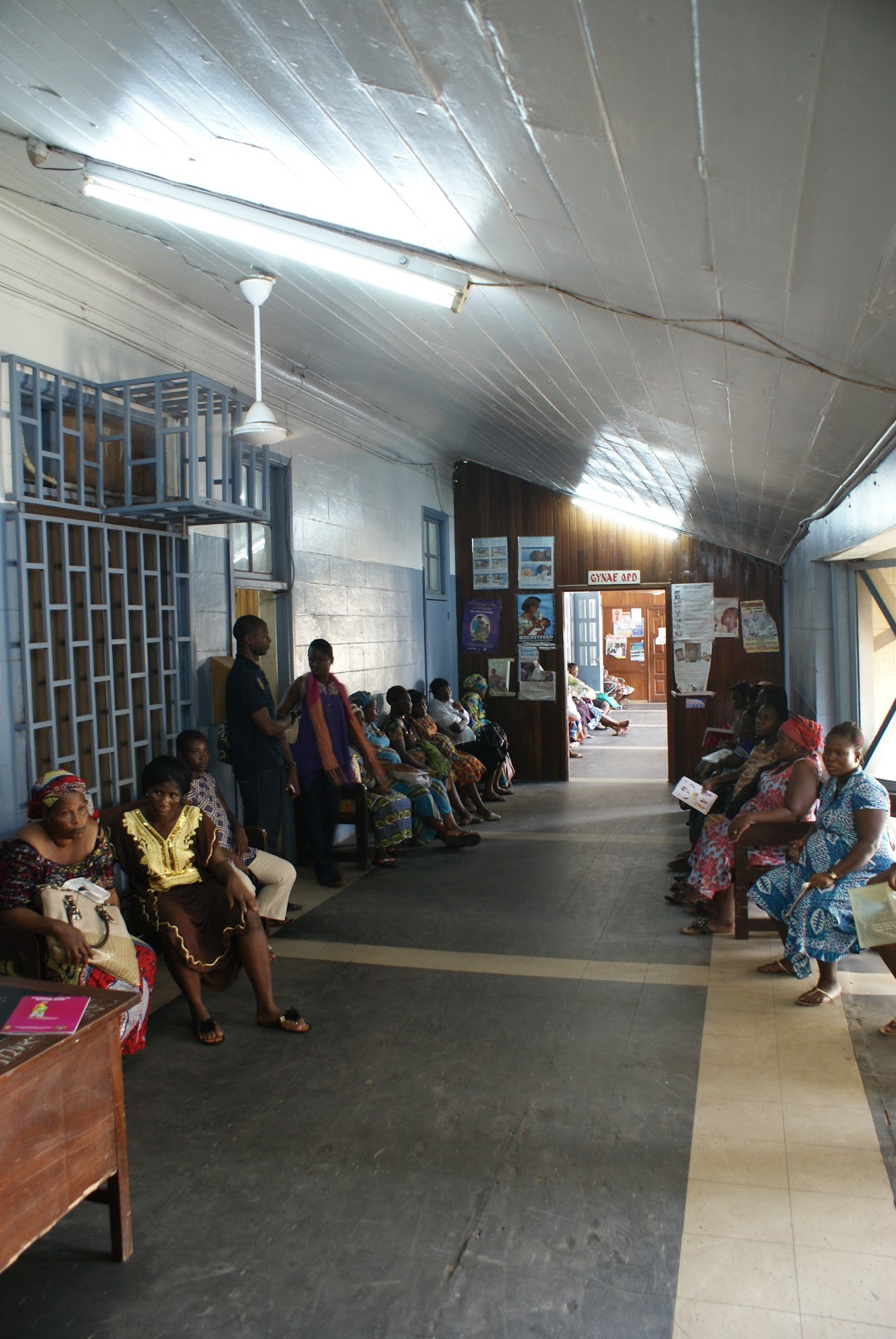
Now imagine being in labour and having to wait on a hard wooden bench with several other women in labour. No room for movement; if you try to walk around you get yelled at by the midwifes and immediately pushed back onto the bench. If you finally are examined by a doctor after a couple of hours, you get a slap and a sneer from the midwife if you’d forgotten to take off your underwear before you climb onto the high examination bed, which you first have to cover with your own plastic cover.

Without introduction the doctor starts vaginal examination (contraction or no-contraction). If you touch his arm in a reflex of a pain wave from a contraction combined with the painful examination there is a disgusted “DON’T TOUCH ME!!” shout from the doctor that will definitely keep you from making that mistake again. After the examination you have to go back to the bench, until you are at least 4-5 cm dilated (and you are lucky enough that someone examines you at that stage, otherwise you might be waiting even longer). For those who are not familiar with those terms, that is a whole lot of contractions later, and quite far in the whole labour process. At that stage you finally get a bed (if there is one available). Not a private bed, but a bed in a room with 5 other women, in a room that is smelly, hot, dirty, and in a desperate need of some renovation work. If you don’t walk fast enough towards the delivery room the midwife will very willingly push you in the right direction, or shout. But at least you can lie down now. Or actually, you have to lie down now: going outside a one-meter range of the bed is off-limits.

The husband is not allowed to come inside; he (or any other relative) has to wait downstairs in the hospital courtyard until the midwife shouts his name through the window. If he’s lucky it will be to tell him that he has a healthy baby girl or boy, but it can also be to go and quickly buy medicine or water for the woman in labour. No updates on what is happening at the women’s quarters whatsoever.

There is no help with ‘puffing’ away pain of contractions (there is of course also no such thing as antenatal couples pregnancy gym...), there is no explanation from the midwifes during the process. When the time is there the midwife tells you to push, the baby comes, is quickly shown with legs spread to show the sex to the mother and then taken away to be measured and weighed. As you can imagine there is not much of magical amazement at this point. There is mainly relief that this scary, painful, and lonely process is over. Women just lay there, sweaty, hot, and almost in apathy to their surroundings, until they are ordered to stand up again and walk (!) to another room where they can lay down a little while before they have to go somewhere else.

In this way an average of 30 deliveries per day happen at the hospital, which means in peak season (end of March – July) almost 50 a day. Fifty deliveries on a labour ward with only 13 beds (including 4 in the hallway), and a maximum of 4-6 midwifes on duty (with some times some extra students and if you’re lucky a doctor for the first examination). Since it is a referral hospital almost all of these women have or have had complications during pregnancy or delivery, which gives them an increased risk for a complicated delivery.

Altogether you can imagine that a day working at this labour ward can be quite intense. I especially have a very hard time with he way the women are communicated to (or actually the lack of communication towards the women). Orders are shouted, not so many nice words, no comforting. This is surely partly biased because of my different frame of reference, and the way English is used directly translated from Twi (which is a language without the fuss of polite forms, but just ‘you sit now’, ‘you go!, ‘walk to that place’). So with this in mind it just might sounds harsh to me, but the women might not experience it that way... Let’s hope so.

However, standing beside it all, in the difficult position of the intern at the bottom of the hierarchy, it made me feel so powerless! After the first day I did manage to use the time that the doctor was updating the patient record to introduce myself to the next woman in line and do some small talk with some nice words, but still it stayed frustrating. I can’t wait to work in this kind of setting and finally be able to do things how I would want to do them. Because yes, the workload is crazy and it will be very difficult to stay nice, but I really hope that I will be able to do so at least a little bit before examining a woman’s private parts (sorry for the explicitness...).

Even though you all might wonder at this point why I still would want to work in a setting like this, I actually have arranged that I will be going back to Ghana again at the end of May for another internship. This time it will be an actual clinical internship at the paediatrics department of the small district hospital way up north in Bawku (you can Google-map it to see that it is quite difficult to get much more Northern than that, on the border with Burkina Faso and Togo). Before coming to Ghana I bumped into a Dutch doctor that I knew from my internships in Holland at the embassy in The Hague. He was preparing his documents to start working in Ghana for a longer period of time, so we exchanged contact details. So after coming home in a bit more than 2 weeks, I’ll be leaving again for another 6 weeks at the end of May, but this time not in the urban setting, but in an area where I’m the only white person together with the other doctor... I will try to write updates during that period too. And after that I will stay in Holland for quite some time again. Promise...

For now only one more week of work, mainly at home to work on my data from the research (I got a bit stressed-out at the hospital when I thought about all the stuff I still need to do for my thesis...) and then Evelien is coming to visit for a final week of travelling up north! I couldn’t believe it when she spontaneously told me she wanted to book a flight, and then just did it within the next 48 hours! I just have the best friends!

Oh... and it’s time for another list of fun stuff, because besides working I also experienced some other fun things like:

... climbing the highest mountain in Ghana (not even 900 m high, but when I came to the top I looked like I walked through a fierce Dutch autumn shower... yes, sweaty business, blimey it was hot!!)
... hiking through beautiful butterfly-filled jungle to a quiet waterfall in the Volta Region (followed by a refreshing plunge of course, using the fact that we were the only one there... magical!)
... crossing shimmering Lake Volta by bridge in a tro-tro going back to Accra from the ‘mountains’
... realising that I really know my way around here by helping out some newly moved in roommates
... starting to talk Ghanaian English (‘oh, sorry-oh!’, ‘Ej! Why?’ [a response to anything that might surprise you or you think is not nice], ‘Oohwokay! [the response to anything. Any-thing!] ‘She’s not picking.’[she’s not answering her phone], ‘Flash me!’[please let my phone ring once so I have your number], ‘I’m coming’ [just wait a minute... or longer])
... not being surprised that all the babies here are actually born with very light skin, sometimes it makes you wonder whether the father is Caucasian, but he never is.
... having people recognise me at some places we go to regularly (the gym, our favourite restaurant after going to the gym, the women in our street)
... going through my phone contacts and not thinking it strange that it is full with: ‘Wisdom’, ‘Nice-one’, ‘Iron Man’, ‘Love’, 'Divine', and more...
... not being surprised anymore that a taxi driver happily tells me that he is married but available (or MBA for short).... Ghanaians really have a different view of monogamy!

See you all very soon! But probably I’ll write one more post before that.

xxx


Weighing infants at the postnatal clinic

Scaring away the evil eye with infant eye-liner :)

One of the midwifes, I just love the uniforms!

Waiting for antenatal care

Scary!

That's what I call green!

Fresh jungle streams, I just love water!

Unfortunately a bit cloudy, but still a nice view from Afadjato Mountain


In the jungle, the mighty jungle...

Tagbo Fall... ain't it a beauty?

Karin and I at the Wli Falls

Wednesday, 13 March 2013

Paradise Paradox


There is a woman walking on the beach. A big bowl full of bananas on her head, a baby tied on her back with a piece of colourful cloth. A toddler wobbles behind her, trying to keep up in her sandy footsteps. She is not in hurry, nobody is, and stops to stare at the weird happenings in the sea during weekends. White people in underpants and brightly coloured t-shirts trying to go with the waves towards the beach. Every one of them on a small floating flat board-boat. When arriving there they turn around, drag the board back against the waves and repeat it. Often falling off the board, or standing for not more than a few seconds before disappearing head-first in the salty foam. She stops, stares, and after a while continues on her path.

Tourism is a strange thing. This weekend Karin and I went to Busua, a town known for the first surfing school in Ghana. Quite well outfitted with budget places to sleep and beach shacks serving freshly caught lobster. A town that realised that tourism is something you can make money off and to do that they should make the white youngsters happy by creating the backpacker-paradise-paradox. The feel of leaving your comfort zone, experiencing ‘The Real Africa’, by serving Momma’s Apple Pie in hammocks on the beach with Bob Marley on the background. In this town it is not apple pie, but pancakes that comfort the backpackers. Busua has Daniël the Pancake Man (who literally came up to us one morning saying: “Hi! I am Daniël the Pancake Man!”) and The Juice Man (“Would you like some of my juice?” Uhm... Excuse me? “Your friends like my juice!”) who walkes around with plastic bottles filled with fresh fruit juices. Soon all beach huts and eating-places started serving pancakes, and the backpacker scene of Busua flourished. Top it up with a lost Australian guy making the world a better place one surf at a time and you have backpacker paradise...

It is good, I guess... Tourism brings business, business brings money, money brings food on the table. But it is weird. It makes me feel strange to ‘relax’ in a town where most of the people don’t really live with the concept of ‘holiday’. How do you explain to someone who just fishes 6 days a week (not on Tuesday, which brings bad luck) that it is normal for those obruni’s to do nothing (like laying practically naked in sand and the sun for enjoyment, which make them look brightly red in the evening) and even for a few days in a row! Not even to mention the worrying business around ‘volunteer experiences’ that is enormous here, including ‘volunteering’ at a backpacker hang-out at the beach, serving cheeseburgers to the other travellers. Apparently our urge to feel like we are helping the world has fogged our ability to actually do good. ‘Ah! You are painting an orphanage! Good for you! So you are paying a 600 euro flight and over a thousand euro to your volunteer organisation to do a job they could have paid a local person to do with all that money you are spending now to give yourself the feeling of abundant karma credits? What a sacrifice of you... living in Africa and all.’

But before I get too hypocritical and cynical (after all, I also did a year of volunteer work in India when I was 17/18... which I still think is an experience that changed my life), I have to say that it is really difficult to say right and wrong in situations like this. It is all very ambiguous, that is the difficult thing about it. Only a couple of weeks ago I said to my mom that it is such a shame that Ghana does not fully use its touristic potential with its beautiful coastline and passionate, friendly culture. And now, in a town that actually profits from its nice beach and surf-able waves, I feel slightly weird and wrong. The contrasts are just so big, especially because of the peek into ‘actual’ (can I even say that?) Ghana-life I get through my friends from church and life in the hospital (and my research...).

I am a 'poor student', I have debt from my student loan, but I am extremely extremely rich. Well, not compared to rich Ghanaians, because their lifestyle just goes above my wildest imaginations (like Porsche-Prada-rich), but compared to an average fisherman in Busua, yes, for sure. Just already the fact that I can go away for a weekend, just for fun!

Anyways... sorry for the mesmerizing note this time if you expected some exiting stories of Africa Adventures, but it kind of just came out while typing. But as far as my adventure here goes, I did also surf the waves of Busua. And with my quite lacking sense of balance and immense inflexibility you can imagine what a sight I was! But I loved it. Also, I explored the neighbouring fishing village and walked back through jungle-looking lush green-land. Thinking of the eager children wanting to pose for my camera still makes me smile.

During the week I have been working on transcribing my interviews. Also I sorted out some practical stuff, like transferring money to the bank account of my translator (which is a day-filling activity here in Ghana, quite an experience on its own!), and extending my visa (there went another day...). Topped off with the celebration of Independence Day, time just flew by! Only one more month here... it goes way too fast! 

Women on Elmina Beach (old picture from Karin... but just wanted to post it)

Our guides in Butre (the neighbouring fishing village) showing us the ruins of a fort


Butre


Happy posers :)

:)


Floating fun

On my way back to Busua

Tuesday, 26 February 2013

Sweating like a pregnant fish

Ghanaians love to dance. I have already mentioned this before, but it is definitely worth mentioning again: Ghanaians love to dance. Love. To dance. Big time. Preferably on loud music and preferably just a little bit too loud for the speakers used (resulting in metallic croaky sounding loud music...). Hands, feet, bums, hips, heads, and knees, anything wiggles and twists. Bending and turning in places where I definitely don’t have any joints that I know of.
By now you might be picturing a happy moving young crowd during a night out at your own town, but it doesn’t even come close to the average Dutch student-boy pointing his index fingers in a diagonal up and down motion. This is actual dancing. No accidental moves or drunk jumping up and down, but breath-taking amazing hip twisting and original moves matching the words and typical rhythm of a song (mostly ‘Azonto’ or ‘High life’). And all of this is drenched with sincere and infectious enjoyment.

Friday, two weeks ago, we had a good-bye party of a Canadian girl that lived in Accra for quite some time. She had made some good local friends and managed to arrange some large speakers and a DJ with her roommates, to send her off Ghanaian style: BBQ and dancing in the courtyard of the house she lived at, all night long. That night, when I came home and landed in my bed as tired and sore as from a good work-out, I just couldn’t stop smiling. After the initial staring at a group of dancing guys (so cool!), I just dived in and... well... danced! I might have gotten a bit carried away, but it just didn’t matter, because everybody was just having so much fun! Some guys tried to teach me some proper Azonto-moves (often vaguely inspired from daily motions like pounding fufu). By the end of the night I was happy that there wasn’t much light out, because I literally was soaked. Or as I heard several times that night: “No worries, we’re all sweating like a pregnant fish!” Clearly, Ghanaian dancing + Ghanaian heat + Ghanaian humidity = sweating like a pregnant fish. That saying is a keeper for sure.

The Saturday after my mom arrived in Accra. Sometimes you need an extra viewer to change the way you look at things, or to actually see things again. The popping of her head out of a tro-tro window to take in a street view (just turning it didn’t do the trick) or her big eyes of amazement to passers-by, made me realize how many things I already think of as ‘normal’.  I don’t really think of the messy, slum-like back-streets as shockingly poor anymore, that’s just how it is. But yes, it is very poor, compared to Europe. But for some reason it is also much more nuanced. In a dusty (mainly because of the unpaved roads and the Hamatan, sandy hot wind from the Sahara), smelly (open sewers, sweat), and polluted (no waste pick-up system, too many old cars) city like Accra, the 20-80 rule reigns. This rule of thumb, often used for input of students during schooling, argues that for an 80% result, you need 20% of the effort. To add the additional 20% of the result (to make it 100%) you need 80% more effort. I really think that in Accra it is just not worth the time and the money to keep things looking nice. Within a day colours are faded by the sun and everything is covered in dust. Why spend money on your house to make it look nice, if you can do ten times more with that same money when it comes to fancy clothes, gadgets, and activities? Big, nice houses is just something for the really really rich.

This was one of the reasons why in the beginning I couldn’t really tell if someone was poor or rich, or where on the scale in between. The same people living in these back streets were the ones owning a blackberry and a giant sound system, as well as the ones going to a beach with 10GHC entrance fee during the weekend (which is quite a lot!). It just doesn’t really matter where you sleep, as long as you have somewhere to sleep, eat, and wash yourself. Happiness does not depend on having a shower, a bucket will do just fine. When these basic things are out of reach however, yes, then it really starts being difficult.

Of course, I have the luxury of living in a nice house and having everything I need quite easily available. And I already get annoyed when we don’t have internet for example (I am embarrassed to say, but I am slightly depending on it!). Our very regular water and power cuts lead to the discussion which of the two was worse. The conclusion: both are okay, as long as you know when it happens and it doesn’t last too long. Unfortunately Ghanaians don’t stick to time the way we do, so even if there is a schedule for the power-cuts in Accra, they never stick to it. Oh well... it is just the best excuse for not working and just sitting in front of our house with the rest of the street. Sorry, we had ‘lights-off’!

In between sight-seeing with my mom (which she also actually did on her own for a part of the day! Very adventurous of her!) I actually had a very busy week. My research-assistant Muni (who has been a great great help to me, not just by translating, but also to get things to happen) had to go back to her regular job somewhere way up in the north-east this Saturday, so we basically had to fit all data collection in this one week! This meant interviewing like crazy, and even getting the focus group discussion organized.

That morning of the group discussion was a whole lot of Ghana at once. I asked the women who agreed to participate in the group discussion to come at 8:30 am (quite a normal time here, live starts very early). Around 9:15 the first one showed up. After several reminder calls, two other women showed up between 9:30 and 10:30, after which the other four (“yes, yes, I’m coming! I am on my way!”) decided to not answer their phones anymore and not show up at all. Apparently saying “no” is just too difficult... So I decided to not waste any more time of the three women that came and recruited three more women in their first trimester from the antenatal care. Luckily they agreed on participating... The funny thing was that I felt so guilty for wasting the time of the three women that did come, but they were not surprised at all, just waiting around, blankly staring away, switching to the “low-energy”-mode that Ghanaians have made to an art. Imagine doing that in Holland!

The group discussion was very interesting, and definitely gave me a lot of information (the small stroopwafels and cold water kept the opinions flowing...). I am very much looking forward to analysing my data, because I really think the vulnerability of pregnant women here in Ghana is far greater than I even expected! Starting a clinical trial here seems almost unethical! Anyway, hopefully I can come with some good advice for medical researchers... (For those of you who still are not quite sure what I was researching again, I’ll go into that a bit more next time ;))

After finishing all this (unbelievable!) I headed out with my mom towards Cape Coast and Elmina, where we had a very nice weekend together exploring and relaxing. It took me some time to wind down the first day... Did I really just do my whole data collection in less than two weeks...?! But it was really nice to hang out with my mom, showing her around in this interesting country.

Yet again I’ve managed to write a long post... (I hope you manage to read up to this point!) and I didn’t even talk about:

... the pig family that randomly walked by on the beach
... the fact that my mom really took my advice of talking to all the taxi drivers at heart, which resulted in her hearing the most interesting life stories
... including one of a guy wanting to write a book on how to life your life by acting not waiting :) which would definitely change Ghana for good...
... that I bought fabric and got a dress and skirt made! Can’t wait to see the results
... that I pounded fufu with Sandra (a girl I met through church, who lives in one of the back streets), which basically was a joint venture with her neighbours, some lost chickens, and the beats of “chop my money” in the background
... that I’m surprised that we don’t have more fufu-pounding-accidents coming in at the ER, like crushed hands
... that adultery is such a common thing here, that it has been a major topic with the women in church already almost every Sunday (what to do if your husband...)
... that I have a double identity here (both Geerte, which is impossible for Ghanaians, and Christine). What’s in a name, right?
... that I am very much looking forward to actually working at the labour ward and the obstetric operation theatre the coming weeks

and

... that ‘God is wonderful tea’

Big hug!!

(ps. don't forget to scroll down for pictures, click to enlarge, and the fufu movie!)

My street at dusk

The women at church... and me :)

Walking in Sandra's neighbourhood

Sandra's room is in the house on the left

Mama picking Maringa leaves (very very nutritious!) with Sandra land lady

Making banku

The beautiful Sandra starting the pounding of plantain for the fufu

Me, trying not to get hit by the pounding stick whilst putting the fufu under it...


http://www.youtube.com/watch?feature=player_embedded&v=AiQ7eeiNf2U
(fufu movie)


The result: fufu with groundnut (=peanut) soup

The women waiting for antenatal care at the clinic

Muni ready for interviewing

One of the midwifes in action

The mother of a friend from church, who sells red-red (beans with fried plantain) near the hospital, yum!

Exploring Elmina

The simple joy of a tire :)

Mom making friends

The upward view from the courtyard where the slave trader chose a woman for one night at Elmina Castle


Cape coast... me in action


Elmina harbour


Showing my picture to some kids at Ada (from last blog)

Sewers...

Accra's sewer on my way to the hospital...


Lighthouse of Jamestown (Accra)

Jamestown 'harbour' (Accra)